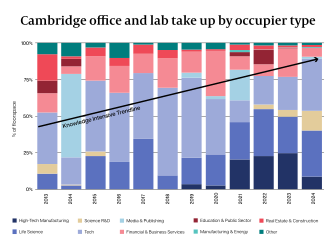
Cambridge’s employment and spatial structures are therefore increasingly characterised by a dominance of scientific, engineering, and computational activities rather than traditional office-based service industries. However, while Cambridge is often characterised primarily as a laboratory market, its office sector is undergoing a parallel structural realignment towards technology. In mid-2025, technology occupiers accounted for approximately half of all office requirements by floorspace, while life sciences and healthcare firms also formed a further substantial share. The longer-term direction of travel points toward an office market increasingly shaped by hybrid science-technology occupiers.
These advances have continued despite a demanding financial backdrop. While late-stage funding for life sciences in Cambridge remains relatively resilient, early-stage VC investment has moderated from its pandemic-era peak, a challenge for a city which is a hot bed of university and research-institute spinouts. Positively, technology funding is improving, with a marked increase in tech VC investment in Q3 2025 expected to underpin a strong annual outturn. This shift underscores the maturation of a broader deep-tech ecosystem encompassing AI, quantum technologies, advanced engineering, and computational science.
Certainly, advances in artificial intelligence are reshaping scientific discovery, from drug-target identification to protein design and predictive modelling. This is transforming the spatial and technical requirements of research-oriented businesses. Laboratories now require greater automation capability, more robust digital infrastructure, and in some cases closer adjacency to computational teams. Offices, in turn, are becoming integral to R&D activity whether combined with lab activities or co-located nearby space, facilitating interdisciplinary collaboration across biology, engineering, computer science, and data analysis.
The implication is clear: future business space in Cambridge, whether laboratory, office, or hybrid R&D, must be designed with significantly greater flexibility and higher technical capacity. Features likely to become essential include integrated/expanded computational areas, increased power and cooling infrastructure, and reconfigurable lab layouts. Allowing for enhanced computing power and greater collaboration between wet-lab researchers and data scientists.
Cambridge’s longevity as a science cluster provides a marker in how other science and tech bases economies in the UK will need to evolve to accommodate structural redefinition driven by the convergence of science and technology.
As advances reshape the nature of discovery, business space must evolve accordingly, ensuring that new and existing assets remain sufficiently adaptable to accommodate the next generation of scientific and technological breakthroughs.