Insight

The 292,000-home question: what the Draft London Plan's housing numbers really tell us

19.7.26

Image of S_220722_N41

The Mayor's new draft London Plan sets a ten-year housing target of around 558,000 homes, roughly a third below the government's assessed need for the capital. In the first of a daily release this week, we examine what the numbers mean for landowners, developers and investors.

The most important number in the Draft London Plan is the one that is missing. The government's standard method assesses London's housing need at 84,884 homes a year, or roughly 850,000 over the ten-year plan period (2027/28 to 2036/37). The draft Plan, published by the Greater London Authority on 16 July 2026 for a 13-week consultation running to 15 October 2026, does not plan to meet that figure in the first ten years. Instead it sets a perceived capacity-derived target of around 558,000 homes to 2037, a shortfall of close to 292,000 homes against assessed need. That gap, and how the Mayor proposes to close it over a longer horizon, is the defining feature of this Plan.


Need versus “capacity”: a deliberate divergence

The Plan is candid that the two figures are different in kind. The 850,000 figure is a national need calculation; the 558,000 figure is what the GLA judges can feasibly be delivered given viability, build-out rates, and land and infrastructure capacity. City Hall's own presentation of the draft conceded that even 558,000 is not deliverable on current conditions but should become so within around two years. At the launch, Deputy Mayor for Planning Jules Pipe said the target was "not credible tomorrow", but that with a plan coming into effect in 2028 three things needed to be in place: "a significant turn in the economy and uptick in the Affordable Housing Grant, and massive investment in transport". He described the 558,000 figure to On London as "the most ambitious and credible plan for delivering more homes now, while also setting out how London can unlock significantly more homes over the longer term". Lucinda Turner, Assistant Director of Planning and Regeneration at the GLA, said the authority "took the 850,000 figure from Government as a starting point", adding that its approach "has to be grounded in reality" and that "558,000 homes over 10 years is the maximum realistic number".

The justification set out in the Plan is that forcing 850,000 homes into ten years would require delivery rates not achieved since before the Second World War, and would risk severe transport crowding, congestion and environmental harm. The context is a capital that has struggled even at far lower levels: net completions reached about 45,700 in 2019/20 (the year before the pandemic and, on the Mayor's account, the highest figure seen in London since the 1930s), before falling back sharply. This represents a notable evolution from the earlier "Towards a New London Plan" consultation, which had floated an option (widely referred to as Option 4A) of meeting full standard method need within ten years. That option was considered and not brought forward, on the basis that it was undeliverable and carried high risk.

It is worth being precise about direction of travel. Although 558,000 for 2027-2037 falls well short of need, it is an increase on the previous London Plan's ten-year aggregate of around 522,870 homes. This “capacity-led” approach is very much based on the GLA’s own perception of what the Capital ability to accommodate growth is. Clear far more Green Belt land could be released, but the justification is that this would have a detrimental impact on congestion and air quality. The evidence underpinning this approach has not yet been released, but will clearly be a key point for discussion at the Examination.   

For the first ten-year period, the Mayor is therefore raising the perceived capacity-based target while simultaneously declining to chase the far larger need figure. That distinction matters, because the standard method is a starting point rather than a binding target, and the Plan will be tested at Examination in Public (expected ahead of adoption in early 2028) against whether it has done all it reasonably can to meet need. The Ministry of Housing, Communities and Local Government has said it expects the Mayor "to take all necessary steps to accelerate housebuilding" and will "carefully review the draft London Plan to ensure it maximises delivery across the capital". The Secretary of State retains powers to direct changes before adoption, as happened to the 2021 Plan. This is the single largest political and legal risk hanging over the document.


The redistribution: growth moves outwards

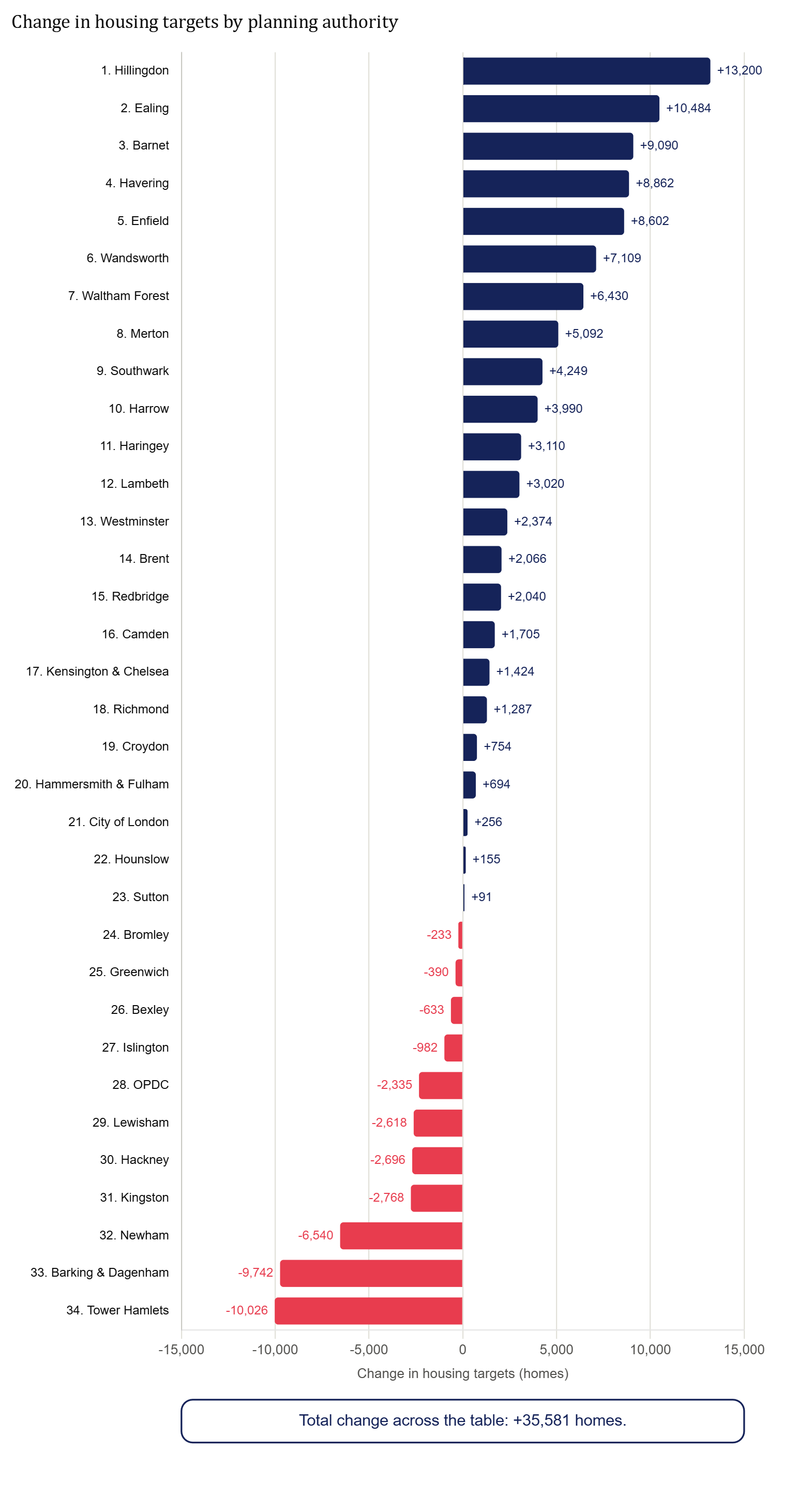
Beneath the headline number, the Plan redraws the geography of growth. The borough targets in the housing chapter's Table 3.1 shift expectation markedly towards outer London, while several inner and east London boroughs see substantial reductions. The pattern reflects both viability evidence and the introduction, for the first time, of a Green Belt (greenfield) component in eight outer boroughs.

The strategic message for the market is clear. Capacity is judged to sit disproportionately in outer London, and the boroughs that have historically carried the heaviest numbers (notably Tower Hamlets, Newham and Barking & Dagenham) are being asked to do less than before. For landowners and promoters, the centre of gravity for large-scale opportunity is moving towards the outer ring.

Brownfield first, but not brownfield only

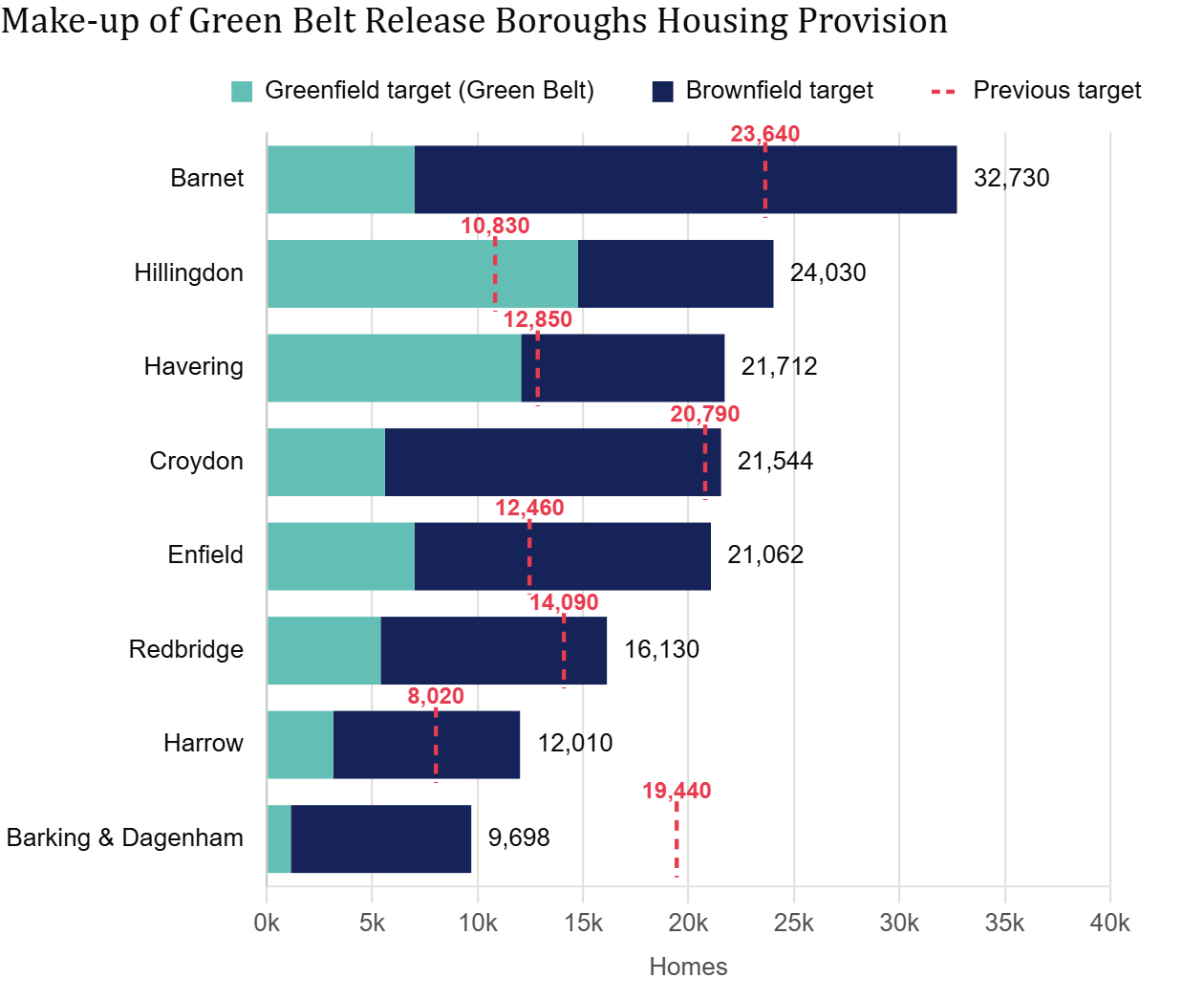
Brownfield land remains the priority, and City Hall expects around 90 per cent of delivery to come from previously developed land. But the Plan accepts that brownfield alone cannot meet London's long-term needs. It therefore introduces a greenfield (read, Green Belt) sub-target of around 56,100 homes over the period, concentrated in eight boroughs: Barking & Dagenham (1,140), Barnet (7,000), Croydon (5,600), Enfield (7,000), Harrow (3,150), Havering (12,060), Hillingdon (14,750) and Redbridge (5,400). Release itself remains a matter for boroughs through their local plans, guided by Policy PV7, which permits limited and selective Green Belt release only in sustainable, well-connected locations that deliver substantial affordable housing (a 50 per cent threshold on Green Belt land), biodiversity net gain and improved public access to green space. The 10 and 20 year key diagrams identify some potential areas of search, but these are currently symbols on a map without defined boundaries.
The scale of the affordable housing ambition sits alongside these numbers. On the GLA's own account, the 558,000 total is intended to include some 220,000 low-cost rented homes and 120,000 intermediate homes over the decade. That ambition would "need to be underpinned" by grant funding well beyond the current record £11.7 billion ten-year allocation, which is expected to fund only around 53,000 homes. The dependence on national funding is therefore not incidental to the Plan; it is central to whether even the reduced target is achievable.

The longer game to 2047, and its dependencies

The Plan seeks to increase its delivery beyond 2037, but it does not seek to make up the shortfall created in the first ten years of the plan. It aims to deliver 850,000 homes between 2037 and 2047, and instructs boroughs to plan proactively for that longer-term capacity. The mechanisms include safeguarding candidate future broad locations for growth, the managed release of industrial and Green Belt land, further phases of Opportunity Areas, and continued reliance on small sites. The Mayor commits to monitor delivery and increase targets as conditions improve.

Critically, much of the post-2037 capacity is contingent on major transport investment that is not yet funded. The Plan links the West London Orbital, a Bakerloo Line extension (ultimately to Hayes) and ‘metroisation’ of South Central rail lines to substantial additional housing capacity, on the order of tens of thousands of homes for each scheme. None of this sits within the Mayor's gift; it depends on decisions in Whitehall. The 20 year key diagram which identifies potential sites, including further Green Belt locations, should therefore be taken with a large pinch of salt. We can also expect further long running discussions over the approach that boroughs Local Plans (which will form a longer 15 year timeline) for the period to 2037 take place at their own Examinations.  

What this means for you

For landowners and developers, the redistribution is the story. Outer London boroughs with rising targets and, in eight cases, an explicit Green Belt component are where strategic land and promotion activity is most likely to be rewarded, particularly around stations and well-connected corridors. Investors should weigh the delivery risk carefully: the 558,000 figure is itself conditional on grant, viability recovery and infrastructure, and the longer-term numbers are more conditional still. And all parties should watch the government's response closely, because intervention by the Secretary of State could reshape the numbers before the Plan is adopted. The consultation is open until 15 October 2026, and there is a clear commercial case for engaging with it where borough-level targets or Green Belt designations affect specific landholdings.


Contributors:

Get in touch for more information

Image of Jamie Sullivan

Jamie Sullivan

Partner, Planning

Jamie brings extensive industry experience of greenfield Local Plan promotion as well as securing planning permission for large scale complex brownfield regeneration proposals.

Read more
602205

Jonathan Bainbridge

Partner, Planning

Jonathan has a strong track record of securing complex, mixed-use planning permissions in sensitive heritage contexts across the golden triangle and the Oxford to Cambridge Arc.

Read more

Local Plan Watch

Our Local Plan Watch highlights the key planning opportunities for landowners, promoters and developers across our region.

Explore our interactive map
Image of WEBSITE HOMEPAGE

Contributors:

Search Bidwells