At the start of the year, the Local Plan submission pipeline already looked stretched with 130 planned for submission in 2026. The latest Local Plan Watch figures suggest that the number has reduced, but not by enough to change the basic picture.
We understand 105 Local Plans are slated to be submitted by the end of 2026, with 56 plans already at examination.
That is a remarkable number.
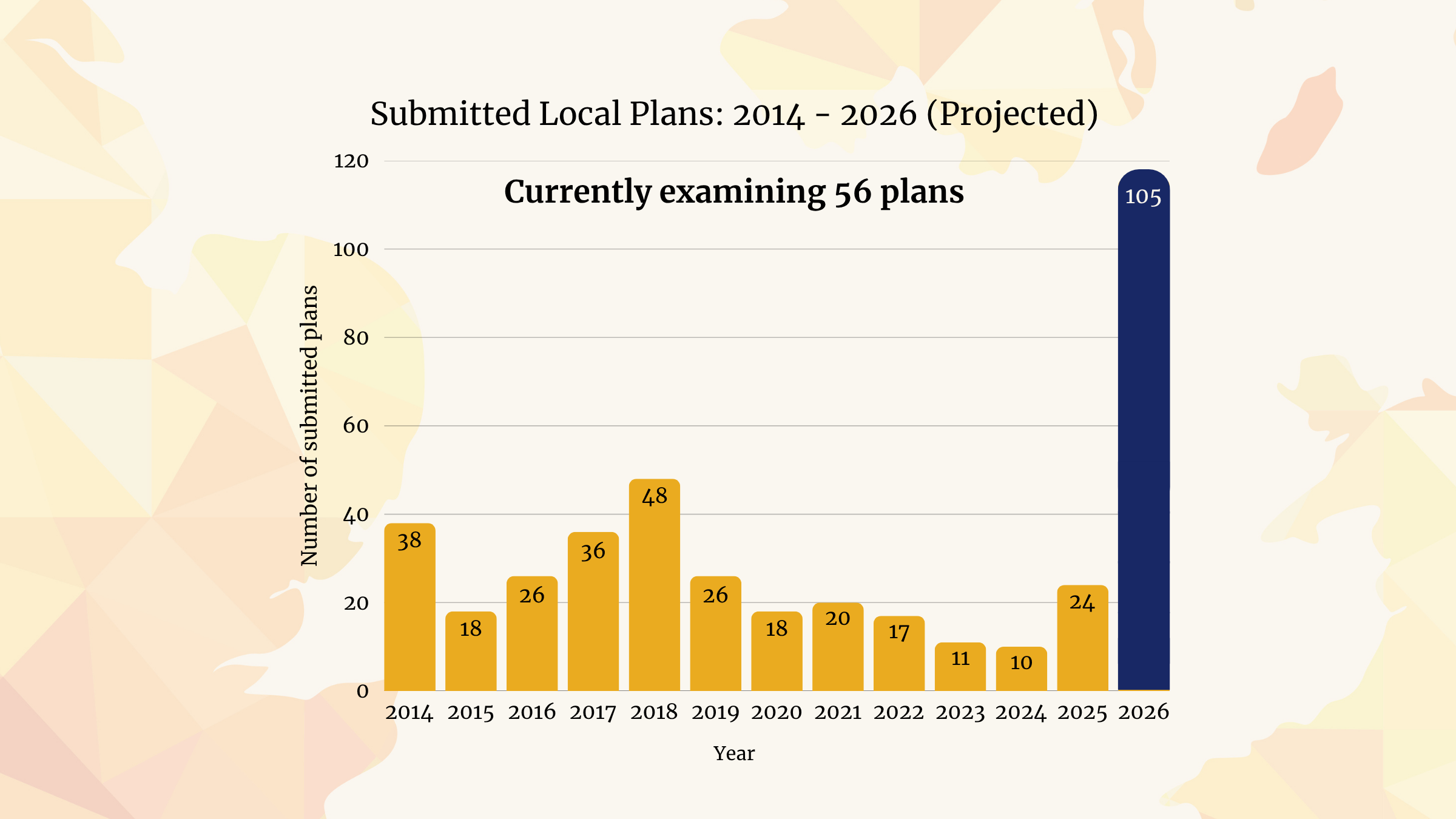
By comparison, 100 Local Plans were submitted in the previous six years combined. The latest projection is therefore not simply a busy year. It is more than six years’ worth of submissions being compressed into a single year. Albeit, these were fairly quiet years by Local Plan submission standards.
Cliff edge transition period pushing submission
The driver is the transition to the new-style Local Plan system. The final date for submitting Local Plans under the existing regulations is 31 December 2026. Plans that do not proceed under the existing system will move into the new plan-making process, which is expected to operate to a 30-month timetable from Gateway 1.
That has created a clear incentive for authorities to reach submission before the end of the year. A number have already concluded that this is not realistic and have moved towards the new system. Even allowing for that attrition, the remaining projected workload is still exceptional.
The Planning Inspectorate has been preparing for this. It has been recruiting additional Local Plan inspectors, and previous projections recognised the scale of the expected increase in submissions. We understand that the number of Inspectors brought on board to deal with Examinations has doubled, but as discussed we are looking at a six fold increase in submissions.
The Biggest Hurdle is Regulation 19 Consultation
The submission deadline is December, but the practical pressure point is much earlier. For an authority to submit a Local Plan by the end of the year, it needs to have completed its Regulation 19 consultation, reviewed representations, finalised its evidence base, prepared its submission documents and addressed the main legal and soundness risks. That makes the summer and early autumn timetable critical.
A large proportions of Local Development Schemes have pointed to June, July or August Regulation 19 consultations. However, we have seen a recent nationwide trend of those timetables slipping into September or October, the turnaround to submission becomes extremely compressed.
That matters because the quality of the submitted plan is now more important than ever. The Planning Inspectorate’s legacy system guidance refers to the Minister’s 2024 letter, which made clear that authorities should not submit deficient plans on the assumption that the examination can be used to fix fundamental issues. It also confirms that pragmatism should not be used where resolving fundamental issues would require pausing or delaying the examination for more than six months overall.
Rushed submissions may still get through the door before the deadline and Inspectors still won’t want to declare a Local Plan unsound; however, hasty submissions that have cut too many corners will run in to an over heated system where the ability to retrofit evidence bases and soundness deficiencies will be more limited.
Why does this matter?
For developers and promoters, the key point is simple: a submitted plan is not an adopted plan.
In a normal year, submission might be treated as a strong signal that the planning context is about to change. In 2026, that assumption needs to be treated with caution.
As we have written about previously [Link article], Local Plans were taking around 2 years from submission to being declared sound. That is likely to lengthen given the number of Local Plans in the system. Other Local Plans may not make it through at all and need to be withdrawn. Where local authorities do not have a five year housing land supply, the window in which the titled balance applies is likely to be longer than it normally is.
The second half of 2027, when tough decisions are made over the many Local Plans submitted at the end of this year is likely to be one of the most dramatic in recent time.