This is the second round of engagement on the same policy (outline consultation took place in November 2025), and it is the round that matters most commercially, because the drafting of the regulation is key to whether this will apply to specific schemes.
The headline is familiar: 50 per cent relief from borough CIL at 20 per cent affordable housing (where half of that affordable housing is not grant funded), rising to a maximum of 80 per cent at 35 per cent. The detail of the draft Community Infrastructure Levy (Amendment) (England) (No. 2) Regulations 2026 is less familiar, and in several places diverges materially from the policy the Government says it is implementing. Anyone modelling this relief into an appraisal, a land bid or a board paper should read the SI rather than the press coverage.
The shape of the relief
Five new regulations (54E to 54I) would be inserted into Part 6 of the CIL Regulations 2010:
-
54E sets the qualifying conditions
-
54F sets the amount (80 per cent at 35 per cent or more affordable housing; otherwise 50 per cent)
-
54G sets the claim procedure
-
54H sets the disqualifying events and clawback
-
54I provides for information notices
Relief is mandatory, not discretionary. Where the conditions are met the charging authority must grant it.
Misconception one: this is not 50 (or 80) per cent off all CIL liability
Three cumulative narrowings apply before the percentage is calculated:
-
Borough CIL only. Reg 54E(2) prohibits relief against Mayoral CIL. The Government's reasoning is that MCIL receipts are committed to Elizabeth Line debt repayments into the early 2040s. This point was pressed hard at the first consultation and has been firmly rejected.
-
The residential part only. Commercial floorspace pays in full. So does student accommodation and co-living, which are "excluded dwellings", along with any dwelling "intended only to be occupied on a temporary basis". Communal space shared with residents of excluded dwellings is also stripped out of the residential part.
-
After all other reliefs. Reg 54F(5) calculates relief on the residual liability once social housing relief has already removed the affordable units from charge.
Misconception two: the £500,000 threshold is easier to hit with more affordable housing
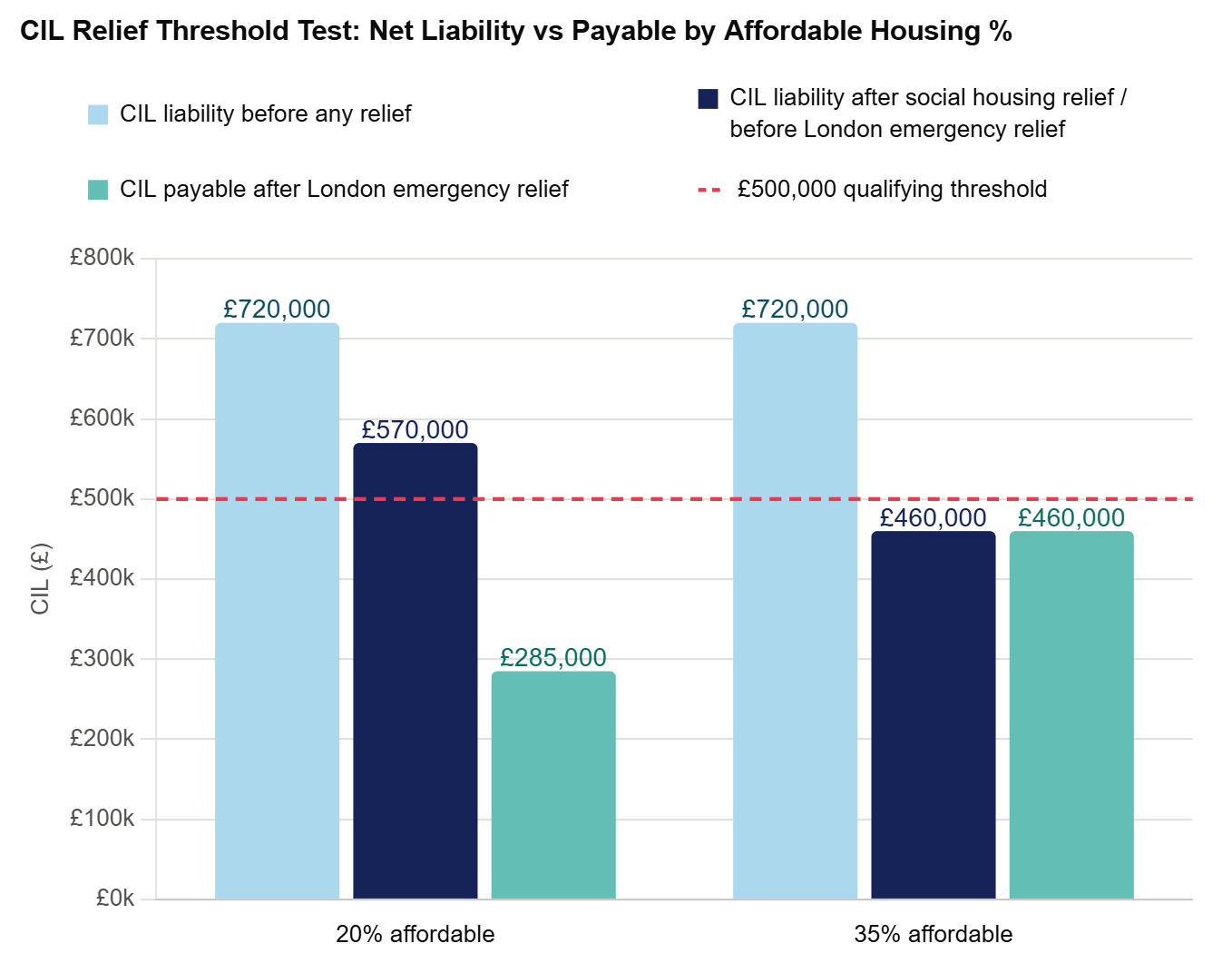
It is harder for smaller developments. Reg 54E(1)(d) tests the estimated borough CIL on the residential part of the total development (all phases), and reg 54E(3)(b) requires the authority to deduct any other relief the residential part would be eligible for before applying the £500,000 test. More affordable housing means more social housing relief, which means a smaller net figure, which makes the threshold harder to clear.
Context setting:
A 40-home scheme, 3,600 sqm residential GIA, borough CIL at £200 per sqm.
-
At 20 per cent affordable (750 sqm): net CIL £570,000. Passes. Relief at 50 per cent = £285,000.
-
At 35 per cent affordable (1,300 sqm): net CIL £460,000. Fails the threshold. Relief is nil.
Misconception three: the CIL relief and the GLA's planning route use the same test
They do not, and the mismatch is capable of disqualifying schemes.
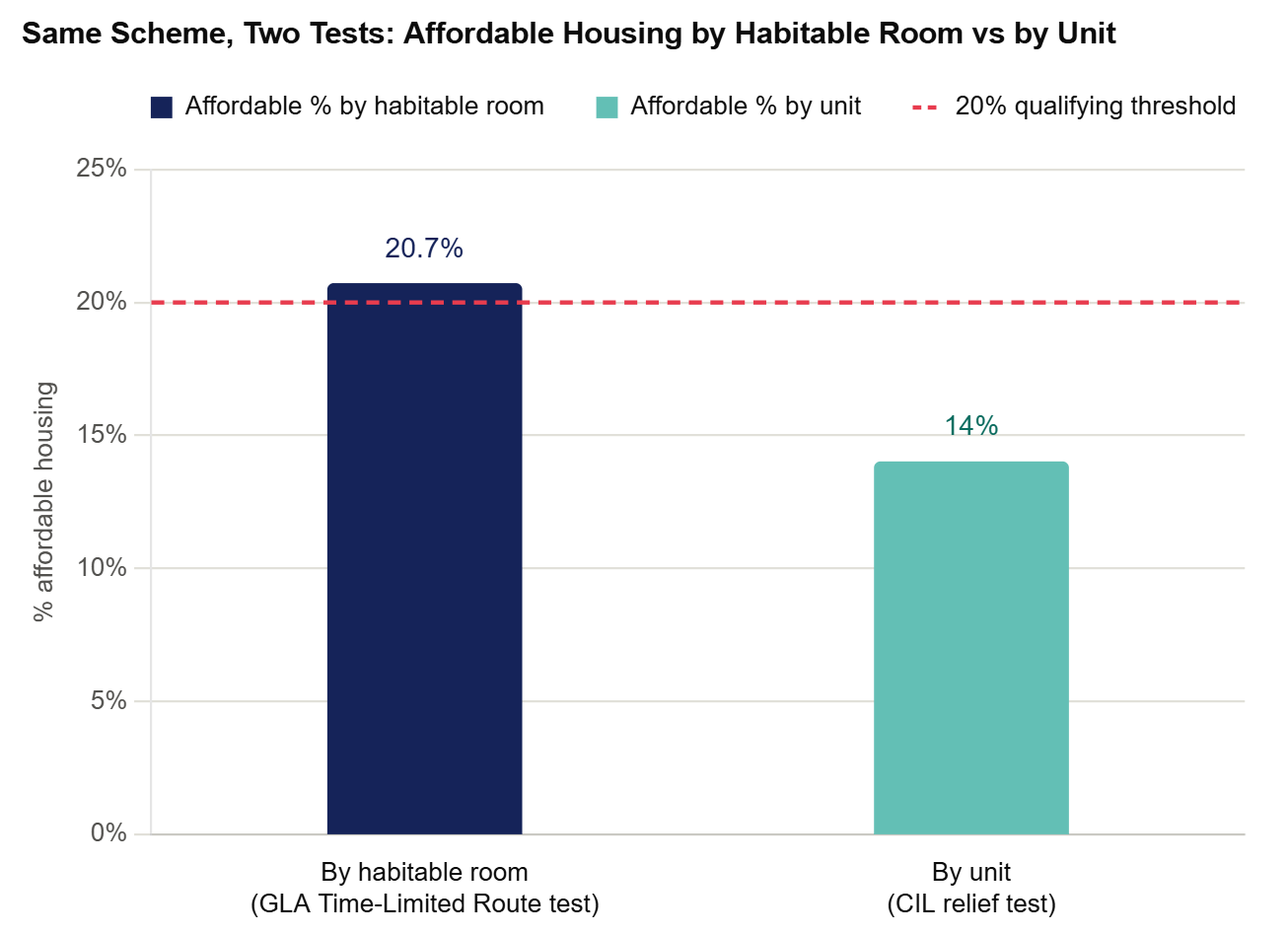
The GLA's adopted Support for Housebuilding London Plan Guidance sets the Time-Limited Route threshold at 20 per cent affordable housing by habitable room (35 per cent on public land and on industrial land where industrial capacity is not re-provided). The draft CIL regulations measure affordable housing as a percentage of housing units in the total development (reg 54E(4) to (8)).
Worked example - 100 homes;
The affordable housing is provided as three-bedroom family homes at four habitable rooms each; market homes averaging 2.5 habitable rooms. Delivering 20 per cent by habitable room requires roughly 14 affordable homes, which is 14 per cent by unit. That scheme satisfies the Time Limited Route and fails the CIL relief condition outright, because the 20 per cent floor in reg 54E(7) is a cliff edge rather than a taper.
Other points to note
Abatement is switched off.
The SI disapplies regs 74A and 74B where London relief has been given, so CIL already paid under an earlier permission cannot be set against the new liability. For the many London schemes being re-planned by section 73 or fresh application, this creates a genuine either/or: take the relief, or take abatement of sums already paid. That calculation needs running before a route is chosen, and it is worth noting that respondents flagged the section 73 interaction at the first consultation and it remains unaddressed.
Sequencing is rigid (as it always is with CIL)
Before a claim can be made: the section 106 must be completed (not agreed in heads of terms) with the affordable housing secured; any grant funding must be confirmed; and every other applicable CIL relief must already have been granted (reg 54E(1)(c)). Then 28 days for a decision, then a commencement notice under reg 67, then start on site. Allow three to four months after section 106 completion in the programme, and treat GLA grant approval as critical path.
The clawback tail is long, and its triggers include matters outside your control
The clawback period[1] runs from the grant of relief to the date of the last compliance certificate for the total development, including all phases. Disqualifying events under reg 54H(2) include: failure to commence before 31 March 2030; failure to obtain a compliance certificate within five years of commencement (extendable only by written agreement); any reduction in the affordable housing in the total development; the total development ceasing to meet any condition in reg 54E(1); and, critically, another relief being granted in relation to any part of the total development after London relief is given.
On a phased scheme where the affordable housing provider for a later phase is not yet identified, a subsequent grant of social housing relief on that phase appears capable of withdrawing the relief already given on phase one.
Excluded land has been tightened
Green Belt and MOL remain excluded, and the Government has confirmed that "as all grey belt land is also Green Belt, it will be covered by the 'excluded land' definition and out of scope of relief". Land designated as open space in a development plan is also excluded.
The commercial decision facing clients with consents in hand
Because relief cannot be claimed until the regulations are in force, and cannot be claimed at all once development has commenced, every consented but unstarted London scheme now faces a timing decision. The SI requires an affirmative resolution of the House of Commons, and the consultation does not close until 18 September 2026, so relief is unlikely to be available before late 2026 at the earliest. Against that, holding costs, contract deadlines and funding conditions run in the meantime.
Where boroughs come into this
Two points that receive little attention. First, the £25,000 application fee is payable on submission (NB – this is a flat fee to the authority to process your claim), is not indexed, and the SI contains no refund mechanism where a claim is refused or lapses. Boroughs may pool the fees, and the Government has said it does not intend them to be used to commission the borough's own viability scrutiny.
Second, the Government has been unusually direct about charging schedules. Twenty-one of the thirty-four London charging authorities have schedules predating 2016, with rates up by more than 50 per cent through indexation alone, and the consultation states that once the commencement deadline has passed, "rates across London should have been reviewed and revised as necessary". A revised charging schedule is permanent, unconditional and requires no statutory declaration. Engagement with borough CIL reviews may be worth more to a long-term pipeline than a time-limited relief, and clients should be tracking which boroughs have review programmes.
The viability evidence: reopened, not settled
The Government’s March Consultation Response moved their position from "the CIL relief is demonstrably necessary to make the scheme viable" to just "the scheme is currently unviable". Questions 18 and 19 on the consultation now put both options back on the table, although the Government is minded to stick with the latter. Developers who welcomed the March shift should not assume it is secure.